
In speaking with IT leaders recently, I keep hearing the same thing. Employees are using AI, with or without IT’s blessing.
The problem: They’re using it in risky ways. For example:
- They’re pasting customer lists into ChatGPT to summarize them.
- They’re feeding contracts into public chatbots to analyze them.
- They’re asking AI tools to review company data they exported to a spreadsheet.
Here’s the part that should worry you. Studies keep finding the same thing, including IBM’s 2025 Cost of a Data Breach report: Employees routinely ignore the AI tools their company actually paid for. Why? Because the sanctioned tools are slower, harder to get into, or don’t do what they need. So, they reach for the public ones instead.
In short, Shadow AI is becoming the default.
I talk to IT leaders who feel like they’re in an impossible spot. They’re trying to manage a workforce that’s already using AI, on tools they didn’t approve, against data they’re responsible for, in ways their auditors and privacy team can’t see. Policy memos don’t fix that.
The only thing that fixes it is giving people a sanctioned path that’s easier than the rogue one. IT needs a way to deliver sanctioned AI that’s easy for the users…without giving up control.
That’s exactly what’s coming next in m-Power.
What’s coming to m-Power this month?
In a few weeks, m-Power is getting a Visual AI Agent Builder. It lets your team design, deploy, and govern autonomous AI agents inside the same platform you already use to build your applications, reports, and dashboards.
If you’ve been waiting for an AI story you can actually take to your CIO without shrugging about data and control, this is it.
Here’s a quick screenshot of the AI builder.
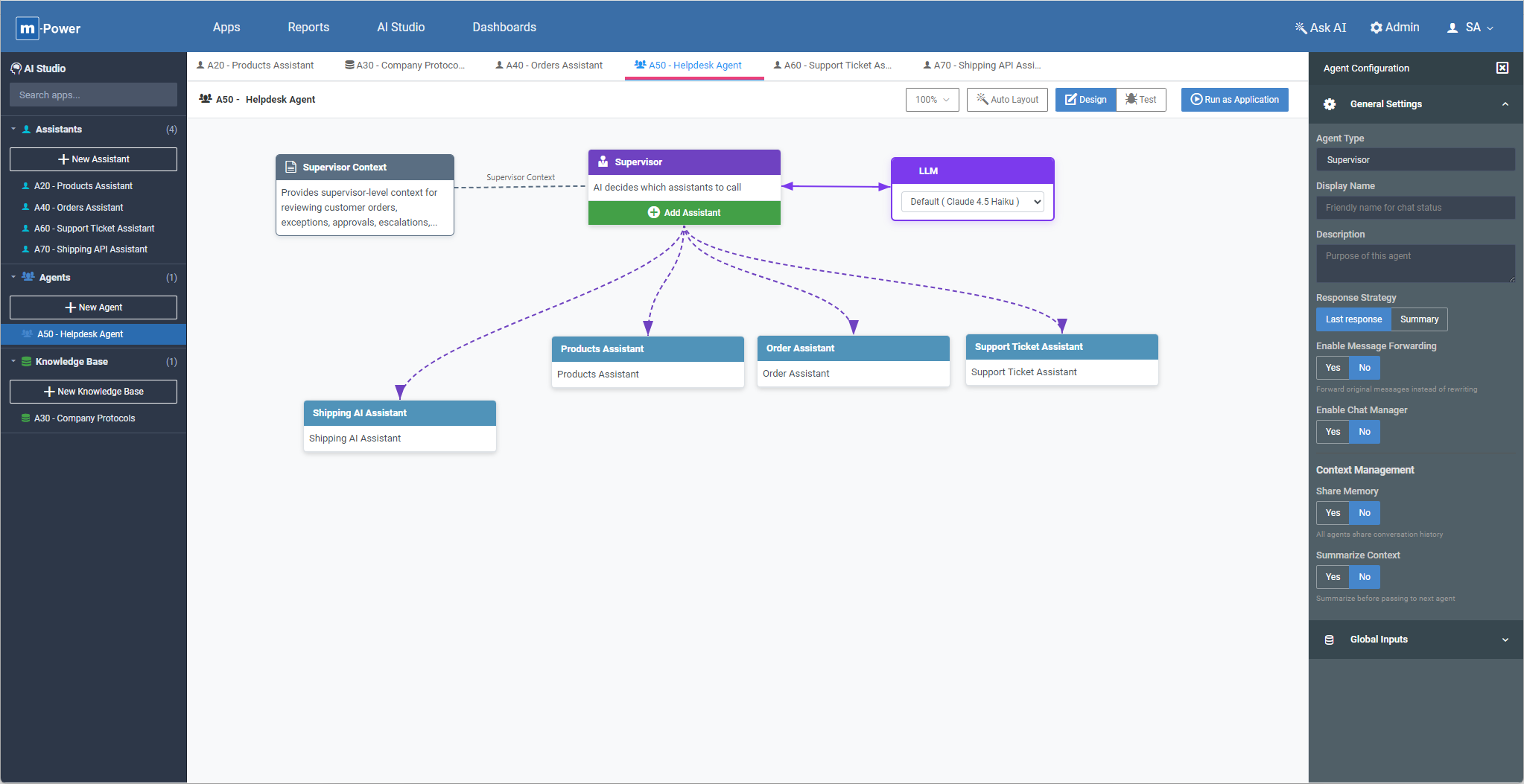
We’ll have more details, screenshots, and live demos rolling out this month. This post is the heads-up.
Agents that do work for you
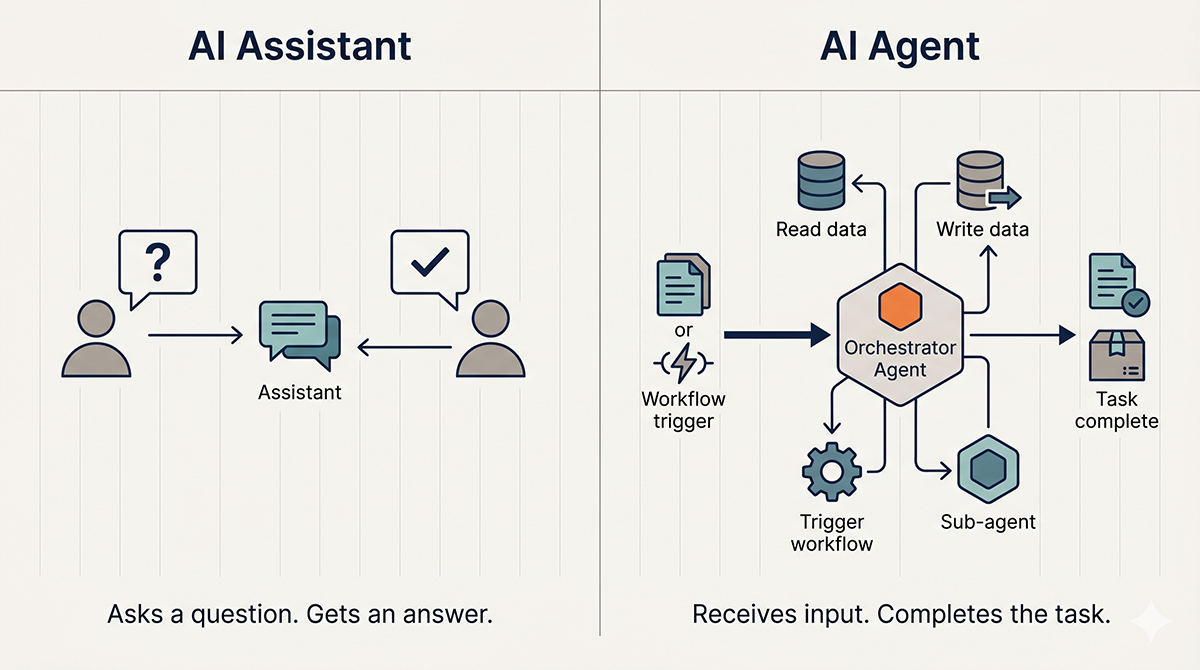
There’s a meaningful difference between an AI assistant and an AI agent.
An assistant answers a question. You ask, it responds.
An agent completes a task. It receives an input, decides what to do, looks up the data it needs, takes the action, and reports back. No human in the middle of every step (unless you want there to be).
The Visual AI Agent Builder coming in May lets you build the second one. An agent can:
- Read live data directly from your databases.
- Write data back when the task calls for it.
- Trigger existing workflows you’ve already built in m-Power.
- Call other applications and other agents.
- Break a big task into smaller pieces and hand each one to a specialized sub-agent.
That last point is pretty huge. That means you don’t have to build one giant agent that tries to do everything. You can build focused agents that each do one thing well, then orchestrate them together for larger processes. You can then re-use those focused agents across other processes.
Why “your own data, your own environment” matters
Here’s the part most AI vendors gloss over.
When an agent runs in a SaaS AI platform, your data has to get there somehow. That usually means a connector, a sync, or a copy. Once it’s there, you’re trusting that vendor’s security model and choices about what their models do with the data they see.
m-Power agents don’t work that way. They run on the same infrastructure m-Power has always run on. If your m-Power platform is on-premise, the agents are on-premise. If it’s in your private cloud, that’s where the agents are. The agent reads from the same database your accounting team or your shop floor or your reporting tools already use. The data stays where it is.
This is a big deal. It’s the reason we think this approach actually clears the bar that most AI tools don’t.
Built for IT control
We’ve heard the same line from IT leaders for two years now: The governed path has to be the easiest path. If it isn’t, employees route around it, and shadow AI gets worse.
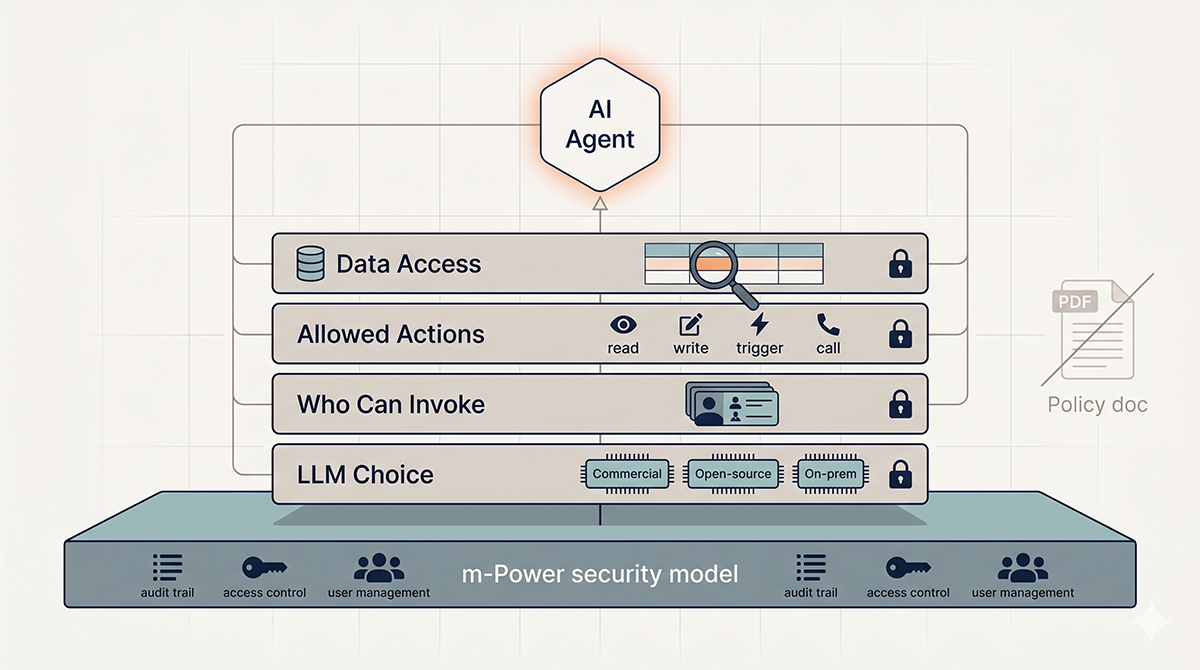
The Visual AI Agent Builder was designed around exactly that idea. Inside it, IT defines:
- What data each agent can access. Down to the table, the column, the row.
- What actions each agent can take. Read-only, write, trigger workflows, call other systems.
- Who can invoke each agent. Tied to the same authentication and roles you already use.
- Which LLM powers each agent. Commercial, open-source, or hosted inside your environment.
Every agent inherits the same security model as the rest of m-Power. The audit trail, the access controls, the user management, all of it is consistent across the environment. There’s nothing new to bolt on.
You can’t enforce a policy that lives in a PDF. The point of building agents in m-Power is to make IT the place where AI gets built without sacrificing control.
Model-agnostic, on purpose
We made a deliberate choice early on: m-Power doesn’t tie you to a single AI model.
The AI landscape is going to shift again, and again, and probably again after that. Pick a platform that locks you into one model, and you’re betting your AI strategy on that vendor’s roadmap. We don’t think that’s a fair bet to ask any IT team to make.
In m-Power, you choose the model that powers each agent. You can run a fast, cheap model for high-volume tasks and a more capable model for sensitive ones. You can swap models as new ones come out, without rebuilding your applications. You can route the most sensitive workloads to a model running inside your own environment, and lower-risk workloads to a commercial API.
The agent doesn’t care which model it’s calling, and you can change it at any time.
A visual build process
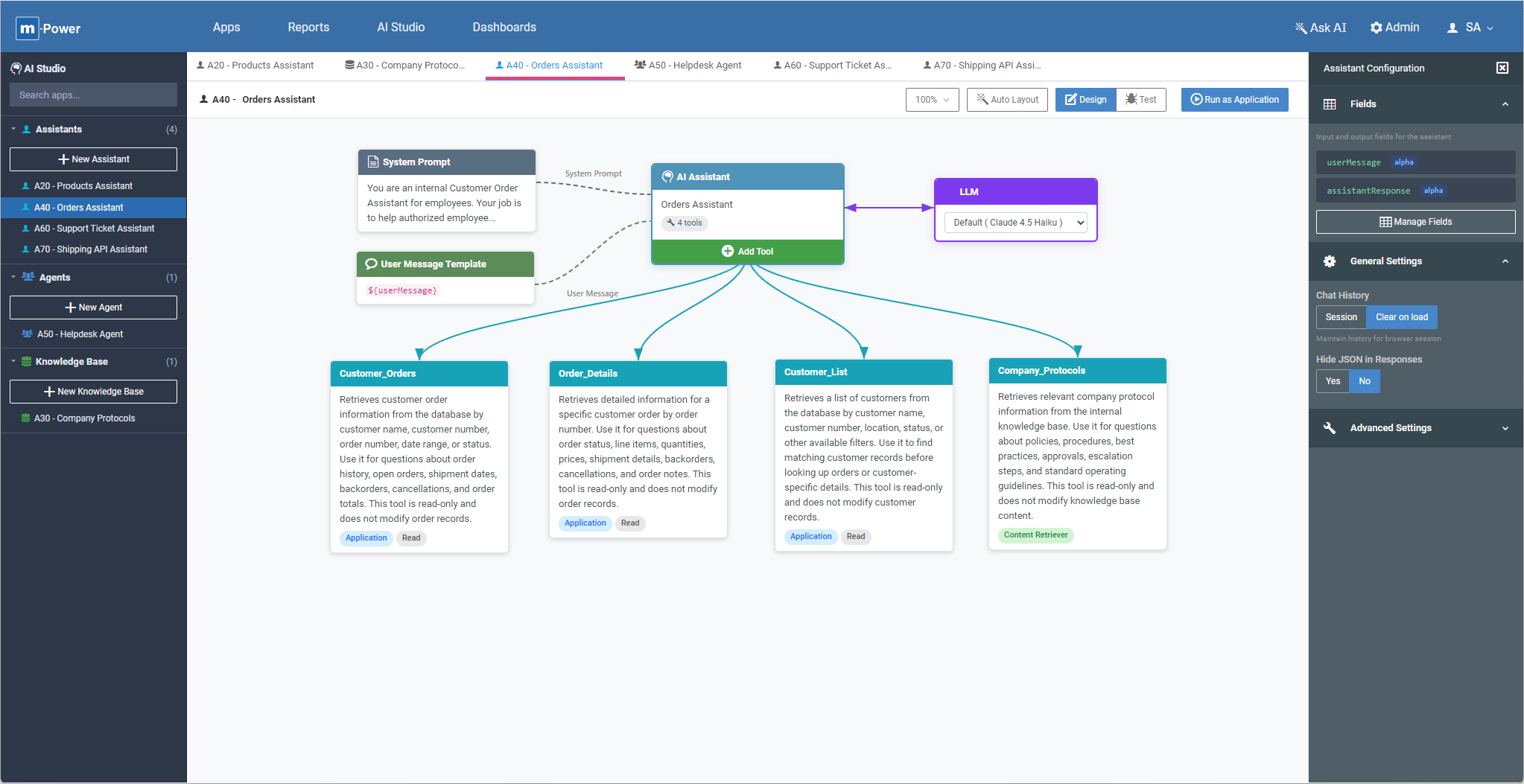
Building an agent in m-Power is a visual process. You lay out what the agent’s job is, what data it can touch, and what actions it can take, all in a single interface. The result is something you can read, review, and change later when the requirements move.
In the meantime
If you’re already thinking about how AI agents fit into your environment, and you’d like to see what m-Power looks like before the upcoming release, you can request a demo today. We’ll walk through the platform, the existing AI capabilities that landed in late 2025, and what’s coming next.
The next phase of AI in the enterprise isn’t going to be won by whoever ships the flashiest assistant. It’s going to be won by the IT teams who give their business a faster, safer, governed path to building agents on their own data. That’s what we’ve been building toward.
More to come in a few weeks.