

Updated October 2026 with 2026 survey data from Broadcom, Flexera and NTT DATA, and corrected figures from IDC and Deloitte.
Something interesting is happening in IT departments right now. The same leaders who spent years migrating workloads to the cloud are quietly moving some of them back.
Not all of them. And, I’m not trying to say that businesses are now rejecting the cloud or anything like that.
However, there’s a growing push for cloud repatriation because the math stopped working for certain workloads and the governance requirements changed faster than anyone expected.
In case you’re unfamiliar with the term, let’s quickly define it.
What is cloud repatriation? Cloud repatriation is the process of moving applications, data, or workloads out of a public cloud environment (like AWS, Azure, or Google Cloud) and back to on-premise infrastructure or a private cloud. It’s rarely a full cloud exit. Most often, it’s a targeted move of specific workloads where the cost, performance, or compliance profile makes more sense outside the public cloud.
If you’re an IT director or CIO watching your cloud bills climb past projections every quarter, you’ve probably at least considered it. Cloud repatriation is a strategic shift happening across industries. Let’s get into what’s driving it, why AI is accelerating the trend, and how to evaluate what belongs where in your own environment.
The Cloud Costs Driving Cloud Repatriation
Most organizations overspend on cloud. IDC found that close to half of cloud buyers spent more than they expected in 2023, and 59% expected to overspend again in 2024. In Flexera’s 2026 State of the Cloud survey of more than 750 cloud decision-makers, 85% named managing cloud spend as a top challenge, and wasted cloud spend rose to 29%, its first increase in five years, as AI workloads grew.
The problem isn’t that cloud is inherently overpriced. It’s that the pricing model rewards unpredictability. I’m talking about things like storage tiers, API call charges, cross-region data transfer, and more. These add up in ways that are almost impossible to forecast accurately, especially for data-intensive workloads that run around the clock.
The examples are piling up. 37signals, the company behind Basecamp, had an annual AWS bill of $3.2 million. They moved away from the cloud. Their projected savings over five years? More than $10 million. GEICO spent a decade migrating to the cloud, watched costs climb 2.5x to over $300 million annually, and is now building private cloud infrastructure on Open Compute Project hardware.
As 37signals co-founder David Heinemeier Hansson wrote in 2022: “Renting computers is (mostly) a bad deal for medium-sized companies like ours with stable growth. The savings promised in reduced complexity never materialized.”
Why Cloud Repatriation Is Happening Now
This isn’t 2018, when “lift and shift to the cloud” was the default recommendation. Several things have changed since then that make repatriation a legitimate option for certain workloads.
The cost math has flipped for steady-state work. Broadcom’s internal analysis found that modern private cloud delivers 40-50% lower total cost of ownership for steady-state workloads compared to public cloud. They moved critical workloads off public cloud database-as-a-service and saved over $10 million.
Data sovereignty is tightening. According to the Nutanix Enterprise Cloud Index 2026, 57% of IT leaders feel the need to run infrastructure within a single country. Regulatory pressure in financial services, healthcare, and government is intensifying. The EU-U.S. Data Privacy Framework remains uncertain. For regulated industries, keeping data on-premise is becoming a requirement.
Vendor lock-in has real consequences. Once you’re deep into a cloud provider’s ecosystem, the switching costs are enormous. Every proprietary service, managed database, and serverless function you adopt makes the exit more expensive. Companies that spread across multiple providers only multiply the problem.
The hardware has caught up. Modern server infrastructure is dramatically more powerful and cost-effective than it was five years ago. The gap between what you can do on-premise and what you can do in the cloud has narrowed significantly.
The Numbers Behind the Shift
Here’s where it stands:
- 83% of enterprises are considering moving workloads from public to private cloud, and 50% have already moved some (Broadcom Private Cloud Outlook 2026, 1,800 senior IT decision-makers at companies with 1,000 or more employees, surveyed February to March 2026)
- Their top three reasons were security and compliance (51%), cost predictability (39%) and performance (39%), in the same survey
- 73% of organizations run hybrid environments (Flexera 2026 State of the Cloud)
Very few are leaving entirely, though. Only 8% to 9% of companies plan to move entire workloads off the cloud (IDC, October 2024). This isn’t a cloud exodus or anything. It’s a strategic recalibration toward hybrid cloud, where each workload earns its placement. Companies are getting smarter about what belongs where.
As IDC research VP Natalya Yezhkova put it: “CIOs should be reassessing whether the public cloud is delivering value, because the needs of workloads change, regulations around workloads change, offerings change whether in price or in functionality.”
AI Is Making Deployment Flexibility Non-Negotiable

Now layer on the other thing keeping you up at night: AI.
Every IT leader I talk to is dealing with the same tension. Leadership wants an AI strategy. Employees are already using AI tools, often without IT’s knowledge or approval. And the governance question keeps getting harder.
Cloud-based AI services add a specific complication: Your data has to leave your environment. When employees paste proprietary data into ChatGPT or when your team builds AI workflows through cloud APIs, that data is being processed outside your security perimeter. For many organizations, that’s a non-starter.
The numbers reflect this concern. KPMG’s AI Pulse Survey found that data privacy as a barrier to AI adoption jumped from 53% to 77% between Q1 and Q4 of 2025. Cybersecurity concerns are even higher, at 80%. And in NTT DATA’s May 2026 research, drawn from nearly 5,000 senior decision-makers, close to 60% of AI leaders named cross-border data restrictions as a major challenge.
The result? A growing number of organizations want to run AI on-premise, over their own data, inside their own security model. Deloitte’s analysis found that on-premises deployment may become more economical than cloud services for consistent, high-volume AI workloads once cloud costs pass 60% to 70% of what equivalent on-premises systems cost. It also notes that some enterprises already see monthly AI bills in the tens of millions of dollars. In Broadcom’s 2026 survey, 56% of enterprises were running or planning to run production AI inference on private cloud, while public cloud use for the same workloads fell from 56% to 41% in a year.
Microsoft added support in February 2026 for running large AI models in fully disconnected, sovereign environments, for organizations that want AI with no connection to the public cloud.
AI governance and cloud repatriation are converging. Organizations want AI. They also want control. The point isn’t that on-premise is always the answer. It’s that you need the flexibility to choose based on the workload, not based on what your vendor allows.
Cloud Repatriation: What Actually Belongs On-Premise
Cloud repatriation doesn’t mean abandoning the cloud. It means having the flexibility to put each workload where it actually performs best, instead of defaulting to “cloud-first” for everything.
Strong candidates for on-premise:
- Steady-state workloads with predictable resource needs
- Data-intensive applications (databases, analytics, reporting)
- AI and machine learning workloads over proprietary data
- Applications with strict compliance or data sovereignty requirements
- Core business systems that run 24/7
Cloud still makes sense for:
- Burst or elastic workloads with unpredictable demand
- Global customer-facing applications that need edge presence
- Dev/test environments and rapid prototyping
- Managed services where the provider’s expertise exceeds your team’s
The key is making the call workload by workload. Cloud is the right answer for plenty of workloads. On-premise is the right answer for others. What’s changing is that IT leaders are insisting on the flexibility to make that decision themselves, instead of having it made for them by a vendor or a five-year-old migration strategy.
The Development Platform Question
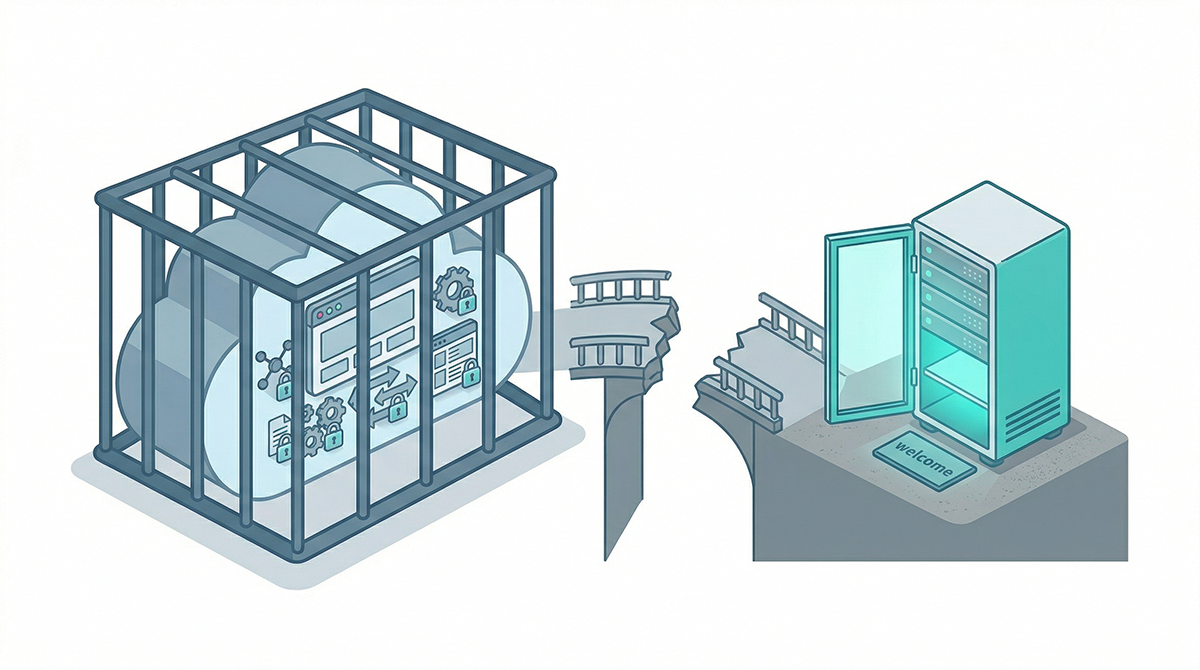
Here’s the part that doesn’t get enough attention: Your choice of development tools determines whether you even have the option to repatriate.
Most modern low-code and development platforms are SaaS-only. Should they be? I have strong feelings on that topic, which I wrote about in another article: What software should NOT be SaaS? In short, when you use SaaS-based low-code tools, they run in the vendor’s cloud. Your applications, data connections, and business logic are all hosted on infrastructure you don’t control. If you decide next year that a workload belongs on-premise, you can’t just move it. You’re locked in.
This is where the development platform decision becomes a cloud strategy decision. If your platform runs only in the cloud, you’ve already made the choice for every application you build on it.
m-Power takes a different approach. It’s a low-code development platform that runs directly over your existing databases, on-premise, in your cloud, or both. You own the software outright with a perpetual license and no per-user fees. That includes AI. Your team builds AI tools and agents where IT controls the data, the users, and the model. The point is that you choose where it runs based on what the workload needs, not what the platform forces.
How to Evaluate Your Own Cloud Repatriation Strategy
If you’re starting to think about which workloads should come back on-premise, here’s a practical framework:
1. Audit your actual cloud spend against projections. Start with the line-item breakdown. Real cloud cost optimization starts at the workload level, not the invoice level. Where are the overruns? Which workloads cost more than expected? Where are egress fees eating your budget?
2. Classify workloads by demand pattern. Steady-state workloads with predictable usage are your repatriation candidates. Variable, burst-driven workloads are your cloud candidates.
3. Map your compliance requirements. Which workloads have data residency requirements? Which handle regulated data? These are the workloads where on-premise delivers the most governance value.
4. Assess your AI roadmap. If you’re planning to deploy AI over proprietary data, where will that data be processed? Cloud AI means data leaves your environment. On-premise AI keeps it inside your perimeter, but requires infrastructure that supports it.
5. Evaluate your development tools. Are your platforms cloud-only, or do they give you deployment flexibility? If you’re locked into a SaaS development platform, repatriation gets significantly harder for any application built on it.
The teams getting this right aren’t picking sides. They’re making workload-by-workload decisions based on cost, compliance, performance, and control.
Frequently Asked Questions
What is cloud repatriation?
Cloud repatriation means moving workloads, applications, or data from public cloud infrastructure back to on-premise servers or private cloud environments. The main drivers: cost optimization, data sovereignty requirements, and the need for greater control over infrastructure and security.
How much can companies save by moving workloads back on-premise?
Savings vary by workload type and scale, but reported figures are significant. 37signals projects over $10 million in savings over five years after leaving AWS. Broadcom saved over $10 million by moving critical database workloads off public cloud. GEICO, facing over $300 million in annual cloud spend, has cut compute costs by 50% per core through its repatriation to Open Compute Project hardware.
Is cloud repatriation the same as abandoning the cloud?
No. Cloud repatriation is about strategic workload placement, not abandoning cloud entirely. Most organizations pursuing repatriation are moving to a hybrid cloud model where steady-state, data-intensive, and regulated workloads run on-premise while burst, elastic, and globally distributed workloads remain in the cloud.
How does cloud repatriation affect AI deployment?
AI is accelerating cloud repatriation because many organizations want to run AI models over proprietary data without that data leaving their security perimeter. Deloitte found that on-premises AI may become more economical than cloud services for steady, high-volume workloads once cloud costs pass 60% to 70% of what equivalent on-premises systems cost. In Broadcom’s 2026 survey of 1,800 IT leaders, 56% were running or planning production AI inference on private cloud.
What development platforms give you deployment flexibility?
Most modern low-code platforms are cloud-only SaaS products, which means every application you build on them is locked to the vendor’s cloud. m-Power, built by mrc, runs on-premise, in your cloud, or both, directly over your existing databases. You own it outright with a perpetual license and no per-user fees, so the deployment decision stays with you as requirements change.
If cloud repatriation is on your radar and you’re evaluating what your infrastructure strategy should look like as costs climb and AI governance gets more complex, we’d be glad to show you what other teams have built with m-Power. The demo is specific to your situation. We often build something directly over your data so you can see exactly how it works in your environment.
Pingback: The Rise of Private AI Cloud: How Enterprises Are Evolving Beyond Public Cloud to Own Their Infrastructure - Arc Compute