mrc's Cup of Joe Blog

Join us in exploring the world of modern development, evolving technologies, and the art of future-proof software

Education

New m-Power interface makes web app development more intuitive

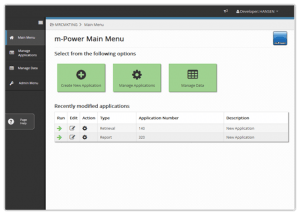
EducationIf you’re looking for an intuitive way to develop enterprise web applications (without programming), here’s some news you’ll love: We just released a brand new m-Power user interface, and it’s the most intuitive one yet! You can find more information about it below, or–if you just want to try it for yourself–feel free to sign up for a free Trial.

m-Power's re-designed interface
m-Power’s re-designed interface
Why did we rebuild the m-Power interface? Because we realize that web application development is evolving. As I explained in this article, new trends have emerged that will forever change the world of web application development software. Two of the most important of these changes include:

5 ways to rejuvenate your legacy applications

EducationMany companies face the same problem: They’re stuck to their legacy enterprise applications and systems. Sure, they’d love to upgrade their outdated system, or replace those legacy applications, but…they can’t.

Why not? Maybe their business relies too heavily on their legacy applications. Maybe past customizations have virtually locked them into their legacy apps. Maybe it’s too risky or expensive. Maybe management doesn’t see the need for modern applications. Whatever the cause, the problem is the same: They’re tied to their legacy applications.

What problems does this cause? Quite a few. While I could explain how it keeps the company from modern features and capabilities and makes them look outdated, those issues are small potatoes compared to the larger business problems caused by legacy applications. For instance, legacy applications:

1. Tie up IT budget: Since legacy applications are more difficult to maintain, they require a good portion of the IT budget. How much? I’ve seen estimations ranging from 70-80%. Think about that. If you’re spending 80% of your budget maintaining the status quo, how can you ever afford modern technology?

2. Keeps IT from innovation: Since legacy applications are more difficult to maintain, they also require much of the IT department’s attention. Of course, if the IT department spends a good chunk of its time maintaining applications, they have little left to spend on business innovation–which, as we explained in this article, is becoming more and more important.

So, what can you do? If you’re stuck with legacy applications that you can’t replace, what are your options?

In this article, let’s explore a few ways to breathe new life into your old applications. If you can’t replace your systems or applications entirely, how can you bring modern features and capabilities to your legacy apps? To help you answer those questions, I’ve outlined some methods to do just that, and touched on the pros and cons of each. Without further ado, here are 5 ways to breathe new life into your applications.

8 questions to ask before developing applications on the cloud

EducationI’ve noticed a growing trend in the business world: More application development is moving to the cloud. More developers are opting for cloud-based development platforms, and more businesses are moving their application development off-site and onto a cloud host.

Why? Many don’t want the burden of maintaining hardware. Others don’t want to bother managing backups or setting up redundant systems. Others like the scalability offered by the cloud. The advantages to such a move are fairly obvious.

photo credit: francisco.j.gonzalez via photopin cc

Now, am I suggesting you should move your development to the cloud? Not at all. I believe in development freedom. If that calls for in-house development, so be it. If that means you move your application development to the cloud, that’s fine too. The most important aspect of development isn’t WHERE your applications are developed, it’s HOW. Focus on building flexible applications that port anywhere–to the cloud or in-house. This opens your future options to make a move to the cloud (and back), if so desired.

That being said–if you are considering moving your development to the cloud–how does this affect development? What changes (or surprises) can you expect when you move your application development to the cloud? What questions must you ask before making the move?

We posed those questions to a few experts in the area, and have compiled their advice (along with some of my own) below. If you’re considering moving your application development to the cloud, here are 8 essential questions to consider:

7 reasons why end users bypass the IT department

EducationIt’s a growing problem: End users are bypassing the IT department, and opting for third-party, cloud-based solutions instead. How prevalent is this issue? According to a recent survey, 71% of organizations say employees are using apps not sanctioned by IT.

Of course, this opens the door for security problems. How can the IT department monitor or secure company data if they don’t even know where it’s stored? How can they avoid security breaches if employees are carrying confidential data around on their personal devices?

How can you address this issue? The automatic reaction for some is full-on war. They want to ban third-party apps, outlaw personal devices, and restrict internet usage. After all, these employees are putting corporate data at risk. They must be stopped! Right?

While I understand the mentality, full-on war is rarely a good approach. Treating users like the bad guys and implementing heavy restrictions will not only waste your time, it will alienate your employees. After all, it doesn’t address the root of the issue: Why are employees bypassing IT in the first place? Do they enjoy breaking the rules? I don’t think so. In fact, I believe they do it because they feel like there’s no other choice.

If you want to control the rise of Shadow IT in your organization, first understand the cause. Learn why employees feel the need to circumvent IT in the first place…and then you’ll better understand how to control (or even harness) it.

So, why do end users bypass the IT department? What can you do about it? To help you answer those questions, we posed them to a few experts in the area, and have compiled their answers below. Here are 7 of the most common reasons why end users bypass the IT department:

7 hidden risks of native mobile app development

EducationAs more businesses build their own mobile apps, we’re seeing an increasing number of mobile app success stories crop up. For instance, here’s a recent article highlighting 4 different companies that use mobile apps to attract customers. Here’s another article from earlier this year highlighting other companies who are using mobile apps to improve business. I could share many more such stories, but you get the point: Mobile apps are taking off in the business world.

I believe this trend is on the rise. As businesses begin to understand the true power of mobile apps, many more will start building their own apps.

This is where things can get dangerous. Blinded by the possibilities, many businesses dive into mobile app development completely unprepared. They don’t understand the risks associated with mobile app development, and are headed for some unpleasant surprises.

Today, I’d like to help you avoid those surprises. I’m going to highlight a few of these hidden risks, with the hopes that you’ll be more prepared when you start the process.

But first, let’s quickly specify which type of mobile app we’re referring to. There are 3 different types of mobile apps (native/hybrid/mobile web), which you can learn more about here. However, today we’re focusing on the risks of developing native apps. Native mobile apps are downloaded via an app store/market and installed on the device itself. I’m addressing native apps because they’re probably the most popular application type, but also come with their fair share of hidden risks.

So, what hidden risks should companies watch out for when they dive into mobile app development? We posed that question to a few experts in the field, and have compiled their advice (along with some of my own) below. Here are 7 hidden risks of native mobile app development:

The 4 P’s of Business Intelligence Success

Education** This guest post was written by Estelle Nicholson. Learn more about Estelle in the author bio at the end of this post. **

When starting a BI project, your first step should be taking a quick look at existing initiatives and the overall culture and support for BI. Understand the “4 Ps” of “people, products, power and pilot” before you launch:

  1. Assess what you already have. Who are the people currently doing business intelligence activities? What roles could they play in a more formalized BI setting? Data experts, analysts, data set owners and compilers – all are key resources for requirements gathering and power use.
  2. What products and tools are people already using? Large data repositories, analytical software, spreadsheets, custom-built systems?
  3. Check your sponsorship or the power behind the mandate or the initiative.
  4. Engage influencers in a pilot early to demonstrate the capabilities of the tool(s) you’re implementing and build support.

7 web application development mistakes that kill usability

EducationNo web developer wants to create a bad user experience. Nobody sets out to make a confusing and frustrating interface that drives users away. But, the sad truth is…this happens far too often.

How often?

According to the online marketing institute, the problems caused by a poorly designed interface are substantial. The numbers indicate that:

  • 85% of users abandon a site due to poor design
  • 83% of users leave because it takes too many clicks to get what they want
  • 62% of users gave up looking for an item while shopping online
  • 40% of users never return to a site because the content was hard to use
  • 50% of sales are lost because visitors can’t find content

The fact is, usability is becoming an essential aspect of web application development. User expectations have changed. Modern end users expect to pick up a web app and understand how it works. Confusing interfaces will only frustrate users and drive them away.

However, many developers build applications which do just that. They unwittingly make development mistakes that hurt their web application’s usability. In doing so, they accidentally alienate their users.

What are these mistakes? In what ways do developers accidentally create interfaces that frustrate their users? We posed those questions to a few experts in the area of usability, and have compiled their feedback below. Here are 7 development mistakes that kill web application usability:

6 common IT practices that should be eliminated

EducationIn a past article, we explored the growing need for IT evolution and outlined 6 keys to a high-performing IT department. The fact is, keeping the lights on is no longer good enough. Modern IT organizations must move quickly, and drive the business forward.

However, I noticed a problem. While all of the keys outlined in that article will help IT departments improve performance, it ignores a critical issue: common IT practices that kill productivity and waste precious resources.

The fact is, you could follow each one of those points perfectly…yet still struggle. If your IT staff focuses its energy on time-wasting and resource-draining tasks, you’ll never drive the business forward. You’ll be caught in a never-ending cycle of being busy, yet ultimately unproductive.

So, what are these common time-wasting and resource-draining IT practices that must be eliminated? We posed that question to a few experts in the area, and have compiled their responses (as well as some of my own thoughts) below. Without further ado, here are 6 common IT practices that should be eliminated.

The dangers of choosing the wrong reporting software

EducationWhat’s the only thing worse than running a business without good reporting software in place? Running a business with bad reporting software in place.

The problems caused by bad reporting software can range from small inconveniences to major financial losses. For instance, bad reporting software can lead to:

  • Lost productivity
  • Wasted money
  • Security breaches
  • Flawed business decisions
  • and more…

How so? Take–for example–the most commonly used reporting tool: Spreadsheets. Why are spreadsheets a dangerous reporting option? Two reasons: They’re inefficient and dangerous:

6 critical guidelines for Business Intelligence beginners

EducationBusiness Intelligence (BI) consistently ranks as one of the top priorities in various CIO and IT surveys. A recent Gartner survey puts BI as the top CIO priority for the last two years running. Forrester comes to the same conclusion.

The fact is, many companies are (or are planning on) adopting a Business Intelligence solution for the very first time. With data growing by leaps and bounds, it’s no surprise that more businesses are looking for ways to capitalize on that data.

The only problem: Most BI implementations fail. It’s no secret. According to various surveys on the topic, anywhere from 60% – 80% of BI projects fail. Yikes.

This paints a grim picture. Implementing BI is the #1 CIO priority, and many businesses will start a BI project in the near future…but most BI projects fail.

Today, let’s explore a few ways to lower those numbers. What must companies who are new to BI do to ensure success? What critical tips should these companies follow? We posed those questions to a few experts in the field, and have compiled their advice (along with some of my own) below. Here are 6 critical tips for BI beginners: