mrc's Cup of Joe Blog

Join us in exploring the world of modern development, evolving technologies, and the art of future-proof software

Education

7 secrets of effective IT departments

EducationWhat’s the difference between effective and ineffective IT departments? Some operate efficiently, while others race around fighting fires, barely keeping their head above water. Some drive the business forward, while others simply keep the lights on…but not much else. Why?

More than ever, this is an especially important question for modern IT departments. As technology plays a larger role in the business, more pressure will fall on IT departments. As more pressure is placed on the IT department, the need for highly efficient IT departments becomes greater than ever.

This brings us to the original question: What separates the effective IT department from the ineffective? What do efficient IT departments do that slow IT departments don’t do? We’ve posed those questions to a few experts in the area, and have compiled their advice below. While I realize that we can’t possibly touch on every reason, here are 7 important traits of effective IT departments.

Web app usability: 7 small UI elements that make a big difference

EducationIn his book, “The Tipping Point,” Malcolm Gladwell explains how it’s often the little things that make the biggest difference. We might assume that big results come from big changes, but that’s not always the case.

I think the same holds true for web application usability. Sometimes it’s the small UI elements that make the biggest impact. If your web applications frustrate or confuse users, or if you just want to improve usability, you might just need a few small changes.

Today, let’s take a closer look at web application usability–specifically focusing on those small user interface elements or concepts that make a big difference. I’ve compiled 7 simple ways to improve your web application’s usability, without performing a major overhaul.

6 key enterprise application development trends of 2014

Education“It is not the strongest of the species that survives, nor the most intelligent that survives. It is the one that is the most adaptable to change.” –Leon C. Megginson

As we start 2014, I believe that quote applies perfectly to the evolving world of enterprise application development. After all, web application development is undergoing some major changes. For instance, consumer devices have infiltrated the workplace. HTML5 will become the new standard this year. The cloud has matured, now offering even more business advantages. I could go on.

photo credit: sntgmdm via photopin cc

The point is, these recent tech trends will forever change enterprise application development. As technology plays an increased role in business in the coming years, companies that adapt to these changes will have an advantage. Companies that don’t will fall behind.

So, how is enterprise application development changing? What big trends can we expect in the coming year? In this article, we’ll examine some major trends, and explain why they’re so important. While this certainly isn’t an exhaustive list, the following includes some of the most important trends to watch in 2014:

10 most popular articles from 2013

EducationAs 2013 draws to a close, I’d like to thank you for taking the time out of your day to read this blog over the past year. Of course, if there are any topics you’d like me to cover in 2014, please share them in the comments.

Over the last 12 months, I’ve written many different articles covering a variety of topics. Today, I’d like to highlight the most popular of those articles and share them with you. In case you missed any of them, here are the most popular posts I’ve written over the last year, as determined by the readers of this blog. I hope you find them interesting:

6 free white papers and guides for IT leaders

EducationWhat are the most pressing issues facing your business as we head into 2014? What technology problem(s) is your company facing that you plan to address in the coming year? I’m curious–feel free to share in the comments.

That being said, working in the IT industry, we see many of the most pressing issues facing companies on a daily basis. Over the past year, I’ve seen certain problems mentioned time and time again. For example, going into 2014, many companies are currently dealing with issues like these:

  • Mobile: From what we’ve seen, many companies are still trying to figure out how they can best take advantage of mobile apps. They’re trying to determine which approach works best for their needs.
  • Data accessibility: Another common issue, many companies still can’t easily access the data stored in their database. They need better reporting and BI tools that makes their data more accessible to even end users.
  • Legacy applications: An all-too-common issue, many companies are stuck to outdated applications and systems. They’re looking for ways to modernize their legacy applications, or breathe new life into their existing systems.

If your company is dealing with any of those issues, or plans on addressing them in 2014, I’d like to help. I’ve compiled some of our most popular white papers and guides that relate to the common issues mentioned above, and outlined them below. Here are 6 free white papers and guides that might help you address your company’s pressing issues as you head into 2014. I hope you find them useful:

Weekly recap: 9 common mistakes developers make, mobile predictions for 2014, and more…

EducationEvery week, I share the most interesting and useful tech articles that I’ve found over the past week. This week’s top articles focus on common mistakes developers make, mobile predictions for 2014, and more. I hope you find them useful:

Why native apps no longer add up
When native mobile apps first broke onto the scene, competition was sparse. Simply placing an app in the app store gave you a good chance of success. Today, that’s no longer the case. The app store now contains over a million apps. Producing an app that even gets noticed is a longshot. Combined with the fact that native apps are more costly and time consuming to create, this further reduces the practical value of the native approach.

5 ways IT will change in the next 5 years

EducationThe death of the IT department has been greatly exaggerated. I remember seeing predictions back in 2007 that the cloud would eliminate IT departments by 2012. Over the last several years, I can’t even count how many similar predictions I’ve seen.

The fact is, much has been written regarding the effect of mobile usage and cloud computing on the IT department. Many say the IT department will disappear. Others say it will shrink.

Will any of that happen? I doubt it. We’re living in an era where technology plays a larger role in business than ever before, and it’s only growing. Is this the time to scale back on the department that best understands technology? Not for businesses that hope to succeed.

photo credit: Phillie Casablanca via photopin cc

However, while I don’t see the IT department disappearing, I do see it evolving. As consumer-owned mobile devices and third-party cloud applications work their way into the business, the IT department’s role is changing.

Today, let’s focus on that evolution. How is the IT department changing? What will it look like in 5 years? We’ve queried some experts in the area and have compiled their advice, along with some of my own below. Here are 5 ways the IT department will change in the next 5 years:

10 security mistakes web application developers should never make

EducationJust when you thought that the healthcare.gov debacle was finally on the uptick, a “white hat” hacker just testified on Capitol Hill that security was never properly built into the site. He claims that fixing the critical-to-high exposures could require up to a year of work.

Not exactly what you want to hear about a website that stores your most sensitive information.

I bring this up to highlight an important point: Despite the rising importance of proper security, best practices are often ignored. Basic security mistakes still plague many web applications…including healthcare.gov.

photo credit: elhombredenegro via photopin cc

As more development shifts to the web, and more data is stored on the cloud, security is a critically important topic. A single security misstep can compromise confidential business data or your customer’s personal information.

Today, let’s get back to the basics. While web application security is a broad topic, I’d like to focus on the security mistakes that web application developers should never make. These are the “basic” security principles that should never be ignored.

So, what are these security principles? What security mistakes should you never make? To help you answer those questions, we’ve compiled advice from some experts in the field (as well as some of my own) and listed everything below. Here are 10 security mistakes you should never make when developing web applications:

New m-Power interface makes web app development more intuitive

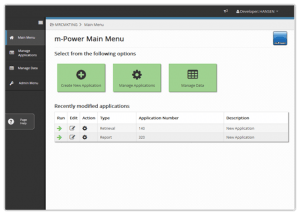
EducationIf you’re looking for an intuitive way to develop enterprise web applications (without programming), here’s some news you’ll love: We just released a brand new m-Power user interface, and it’s the most intuitive one yet! You can find more information about it below, or–if you just want to try it for yourself–feel free to sign up for a free Trial.

m-Power's re-designed interface
m-Power’s re-designed interface
Why did we rebuild the m-Power interface? Because we realize that web application development is evolving. As I explained in this article, new trends have emerged that will forever change the world of web application development software. Two of the most important of these changes include:

5 ways to rejuvenate your legacy applications

EducationMany companies face the same problem: They’re stuck to their legacy enterprise applications and systems. Sure, they’d love to upgrade their outdated system, or replace those legacy applications, but…they can’t.

Why not? Maybe their business relies too heavily on their legacy applications. Maybe past customizations have virtually locked them into their legacy apps. Maybe it’s too risky or expensive. Maybe management doesn’t see the need for modern applications. Whatever the cause, the problem is the same: They’re tied to their legacy applications.

What problems does this cause? Quite a few. While I could explain how it keeps the company from modern features and capabilities and makes them look outdated, those issues are small potatoes compared to the larger business problems caused by legacy applications. For instance, legacy applications:

1. Tie up IT budget: Since legacy applications are more difficult to maintain, they require a good portion of the IT budget. How much? I’ve seen estimations ranging from 70-80%. Think about that. If you’re spending 80% of your budget maintaining the status quo, how can you ever afford modern technology?

2. Keeps IT from innovation: Since legacy applications are more difficult to maintain, they also require much of the IT department’s attention. Of course, if the IT department spends a good chunk of its time maintaining applications, they have little left to spend on business innovation–which, as we explained in this article, is becoming more and more important.

So, what can you do? If you’re stuck with legacy applications that you can’t replace, what are your options?

In this article, let’s explore a few ways to breathe new life into your old applications. If you can’t replace your systems or applications entirely, how can you bring modern features and capabilities to your legacy apps? To help you answer those questions, I’ve outlined some methods to do just that, and touched on the pros and cons of each. Without further ado, here are 5 ways to breathe new life into your applications.