
mrc's Cup of Joe Blog

Join us in exploring the world of modern development, evolving technologies, and the art of future-proof software

Web Development

5 big enterprise application development trends of 2016

EducationSummary: As web application development evolves, old development methods will not address the needs of the modern business. In the near future, those who keep up with changing development trends will have an advantage over those who don’t. So, where is enterprise application development headed in the coming year? Learn more in this article.

7 tips for cost-effective web application development

EducationSummary: Application development is becoming more and more important to the modern business. Your ability to create and deploy applications quickly directly impacts your competitive advantage. But, most businesses can’t afford a team of developers on staff. How can these businesses create the applications they need without breaking the bank?

9 critical lessons web developers won’t learn in school

EducationIn an article last week, we explored the growing IT “Skills Gap” problem. Employers say they’re having more and more trouble finding qualified workers with modern skills.

Why?

While the reasons vary, one big complaint surrounding the issue is the idea that students aren’t learning the appropriate skills in college. They come out of school completely unprepared for the skills demanded by the business world.

While that might be the case, I believe it’s a two-part problem. On one hand, some schools teach outdated technical skills. But, on the other hand, many of the skills required in business only come with experience.

Take web application development for example. A developer might learn technical skill in college, yet be completely unprepared for the real world. He/she might breeze through school, yet struggle to adapt to development in business. Why?

Web application development in the business world is far more than technical skill. It’s about solving problems. It’s about creating solutions that adapt. It’s about communication. I’d say that the lessons a developer learns outside of school are arguably more important than the technical skills learned in school.

What lessons are those? We posed that question to some experienced developers, who delivered some excellent advice. I’ve outlined their input below, along with some of my own thoughts under each point. Sound good? Okay, here are 9 web development lessons you won’t learn in school, yet are critical to your success:

7 habits of highly productive web developers

EducationA recent Forrester study highlights a major shift in the business landscape: More and more, software development plays an increasingly important role in a company’s competitive edge. According to the study, “Companies that are able to innovate quickly with software will outcompete traditional market leaders.”

There’s just one problem: As the study points out, software development is still a problem for the majority of companies. Most are not able to deliver software solutions as fast as the business leaders want them.

photo credit: Nathan E Photography via photopin cc

The fact is, as business moves to the web, software development speed plays a crucial role in a company’s success. The old software development methodologies–in which development projects required months (or even years) to complete–will no longer work. Businesses must permanently shift their development cycle into the “days and weeks” range.

How can businesses improve their development speed so drastically? While the answer to that question varies by company, today I’d like to focus on one area that’s relevant to most businesses: improving developer productivity.

What separates the productive developer from the unproductive? What do the productive developers do differently? How can developers become more productive? We posed those questions to a few experts in the area, and have compiled their advice below. Here are 7 habits of highly productive developers:

Build enterprise web applications without programming (New and improved)

Save TimeIf you’re looking for a way to improve your application development speed, create mobile web apps, or just build enterprise web applications without programming, you should really check out the all new m-Power Trial. It’s recently been revamped with the new m-Power interface we released last month, making application development simpler than ever.
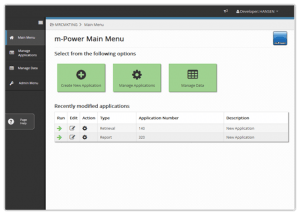
What will you find in the m-Power Trial? Using a simple, on-screen tour, the m-Power Trial will guide you through the process of building enterprise web (and mobile web) apps…all without any programming. Feel free to explore the interface in depth, and even experiment building applications over your own data.

If you’d like to check out the m-Power Trial, just fill out this short form.

New m-Power interface makes web app development more intuitive

EducationIf you’re looking for an intuitive way to develop enterprise web applications (without programming), here’s some news you’ll love: We just released a brand new m-Power user interface, and it’s the most intuitive one yet! You can find more information about it below, or–if you just want to try it for yourself–feel free to sign up for a free Trial.

m-Power's re-designed interface
m-Power’s re-designed interface
Why did we rebuild the m-Power interface? Because we realize that web application development is evolving. As I explained in this article, new trends have emerged that will forever change the world of web application development software. Two of the most important of these changes include:

7 web application development mistakes that kill usability

EducationNo web developer wants to create a bad user experience. Nobody sets out to make a confusing and frustrating interface that drives users away. But, the sad truth is…this happens far too often.

How often?

According to the online marketing institute, the problems caused by a poorly designed interface are substantial. The numbers indicate that:

  • 85% of users abandon a site due to poor design
  • 83% of users leave because it takes too many clicks to get what they want
  • 62% of users gave up looking for an item while shopping online
  • 40% of users never return to a site because the content was hard to use
  • 50% of sales are lost because visitors can’t find content

The fact is, usability is becoming an essential aspect of web application development. User expectations have changed. Modern end users expect to pick up a web app and understand how it works. Confusing interfaces will only frustrate users and drive them away.

However, many developers build applications which do just that. They unwittingly make development mistakes that hurt their web application’s usability. In doing so, they accidentally alienate their users.

What are these mistakes? In what ways do developers accidentally create interfaces that frustrate their users? We posed those questions to a few experts in the area of usability, and have compiled their feedback below. Here are 7 development mistakes that kill web application usability:

7 deadly sins of web application development

EducationWhat percentage of IT projects fail? It’s hard to say. I’ve seen surveys that put the number at 25%. Others surveys push it closer to 70%. While that’s quite a range, the point is this: those numbers are far too high. Even if it is “just” 25%, that’s still 1 out of every 4 projects. That’s too many.

How can we bring those numbers down? Today, let’s focus on ways to reduce failure for one common project type: web application development projects. In this article, we’ll take a look at mistakes that hurt web application development projects. These are chronic bad habits that turn web application development projects into disasters.

What deadly sins do even the most experienced web application developers make? What common web app development mistakes crop up over and over again? We posed those questions to a few experienced developers and have compiled these answers below. Without further ado, here are 7 deadly sins of web application development:

7 things experienced web developers wish they knew earlier

EducationWe just passed our 30th anniversary of software development earlier this year. As I reflect back over that time, it’s largely positive…but there are things I know now that I wish I knew starting out. After all, the more time you spend in any profession, the more you learn (hopefully).

That got me thinking: I’m sure everyone is like that. I’m sure everyone could name one or two specific pieces of advice that they wish they knew earlier. Wouldn’t that advice be useful to those just starting out? I think so.

Problem
photo credit: andy.brandon50 via photopin cc

Today, I’d like to explore that topic from a web application development angle. What do experienced web app developers know now that they wish they knew starting out? If developers could go back in time, what advice would they give to younger versions of themselves?

We posed those questions to some experienced web app developers, and they provided some excellent advice–which can help web application developers of any skill level. I’ve outlined their advice below, along with a few of my thoughts under each point. Here are 7 things that experienced developers wish they knew earlier:

4 common myths of web application development platforms

EducationToday, let’s address a current trend that’s been building steam over the past few years: The increased use of web application development platforms.

Why are web applications development platforms becoming more popular? Because they address many of the growing issues surrounding CIOs and IT leaders these days. For instance, development platforms help CIOs and IT leaders…

  • Automate the development of mobile web applications that work across all devices and platforms.
  • Give end users the self-service options they require while giving IT full control over the data and user access.
  • Bring the most up-to-date and cutting edge development skills to their current staff.

However, while all of those advantages sound great, there’s a problem that make some businesses shy away: Many developers and IT leaders hold a misguided view of web application development platforms. Some confuse them with code generators. Others think of them as IDEs. Worse yet, others make assumptions about development platforms based on their own bad experiences with past code generators or IDEs. For example, many (falsely) believe one or all of these development platform myths: