Summary: Enterprise systems pose something of a “Catch-22.” If you don’t customize the system, it won’t perfectly fit your needs. If you do customize it, you’re locked into that system. In this article, you’ll learn how to avoid these problems and customize your enterprise system without locking your company down. …
Summary: In this week’s article roundup, we learn which trend will have the largest impact on the business world this year, tips for getting your company into the cloud, why we are now in the “Post-Post PC Era”, and more. …
Summary: As web application development plays an increasingly important role in the business world, many companies aren’t keeping up. They’re stuck using old development standards and haven’t yet adapted to modern principles. In this article, you’ll learn which rules developers should follow, and which mistakes they must avoid. …
Summary: This live helpdesk calendar demo highlights some of the capabilities included in m-Power’s new display and maintain calendar template. Check out the demo to see the wide variety of features included with this new template. …
Summary: As businesses create more data than ever before, Business Intelligence is growing. The only problem: Most Business Intelligence projects still fail. In this article, you’ll learn why this happens and key take-aways to help you avoid BI failure. …
Summary: Commonly found in spreadsheet programs (like Excel) pivot tables are a staple of modern business reporting. But, are spreadsheets really the best choice for pivot tables? In this article, you’ll learn why they aren’t, and why the web is a better option. …
Summary: As businesses rely more on data and technology, the barrier between IT departments and the business must come down. If businesses are to succeed in a data driven world, IT must better align itself with the business, and eliminate some common practices that frustrate end users. …
Summary: What separates the successful web developers from the rest of the pack? Oftentimes, it’s not about what they do. It’s about what they avoid. Successful developers avoid the things that waste time, energy, and lead to unproductivity. …
Summary: As these security breaches increase at alarming rates, businesses must improve their application security practices. Learn how 2-factor authentication can protect your applications against one of the most common security risks, and keep your company from a disaster. …
Summary: Despite its growth in the enterprise, cloud computing is still surrounded with misconceptions. These misconceptions can keep companies from the cloud, lead the wrong companies to the cloud, or trap businesses with a bad cloud vendor. Learn how to identify these misconceptions, and make more informed cloud decisions. …
Summary: Poised for rapid growth, Business Intelligence is also on the verge of some major changes. Driven in part by recent trends and development advances, the BI of the near future will shift dramatically from traditional BI solutions of the past. In this article, you’ll learn more about why BI is changing and where it’s heading. …
Summary: Is financial reporting a burdensome task? Do you spend hours (or days) gathering financial data, organizing it in spreadsheets, creating reports, and distributing everything to other business leaders? Learn how a financial reporting portal simplifies this process. …
Summary: Building a mobile app is an expensive and time-consuming task. The problem is, if you can’t give your users a great user experience, no one will use it…and all of that time and money will be wasted. This article will help you avoid that fate. …
Summary: Technology has changed, but many IT departments still operate with outdated or ineffective strategies. Is your IT department one of them? This article lists 6 signs to watch for. …
Summary: Typical dashboards are inflexible–displaying a pre-determined set of metrics in a pre-set layout. Learn how user-defined dashboards fix this problem, and could save your IT department hours of time.
…
In an article last week, we explored the growing IT “Skills Gap” problem. Employers say they’re having more and more trouble finding qualified workers with modern skills.
Why?
While the reasons vary, one big complaint surrounding the issue is the idea that students aren’t learning the appropriate skills in college. They come out of school completely unprepared for the skills demanded by the business world.
While that might be the case, I believe it’s a two-part problem. On one hand, some schools teach outdated technical skills. But, on the other hand, many of the skills required in business only come with experience.
Take web application development for example. A developer might learn technical skill in college, yet be completely unprepared for the real world. He/she might breeze through school, yet struggle to adapt to development in business. Why?
Web application development in the business world is far more than technical skill. It’s about solving problems. It’s about creating solutions that adapt. It’s about communication. I’d say that the lessons a developer learns outside of school are arguably more important than the technical skills learned in school.
What lessons are those? We posed that question to some experienced developers, who delivered some excellent advice. I’ve outlined their input below, along with some of my own thoughts under each point. Sound good? Okay, here are 9 web development lessons you won’t learn in school, yet are critical to your success: …
Does your company rely heavily on spreadsheets? Would you like to learn how to better secure your spreadsheet data and make it 100x more useful to your business?
How? It’s simple. Move it to a database. Before I show you how, let me explain why this is so important. Moving your spreadsheet data to a database helps in a few specific ways: …
Today, let’s explain another important term in the world of web application development: event-triggered messaging. What is it, why is it important, and how does it help your company? Let me explain.
Event-triggered messaging is a web application feature that involves automated email or sms messages sent on a pre-determined schedule, or based on application events. Messages can be triggered by any event, from customer interactions to changes in data and everything in between. …
Every new tech trend comes with varying levels of acceptance among IT departments. When the web first rolled around, some recognized its value and jumped on board. Others sat back and waited. I’ve noticed similar responses to the recent major trends, like mobile and cloud computing.
Now, I’m not going to sit here and tell you which trends to adopt and which to ignore. After all, every company has different needs.
However, I’d like to take a step beyond the recent trends, and focus instead on the new “realities” brought about by these trends. What’s the difference between a trend and a reality? While you can choose whether or not to adopt a trend, realities aren’t up for debate. They’re happening, whether you like it or not. You can’t sit back and see what others are doing. You must adapt.
So, what are these new realities? While this isn’t an exhaustive list, here are 5 realities to which IT departments must adapt: …
Updated September 2026 with industry examples, a comparison with dashboards, a section on AI, and an FAQ.
Today, let’s explain an important type of web report that could be a useful addition to any company’s reporting repertoire: the ranking report (also known as “the top N report”). What is it, why is it important, and how does it help your company? Let me explain.
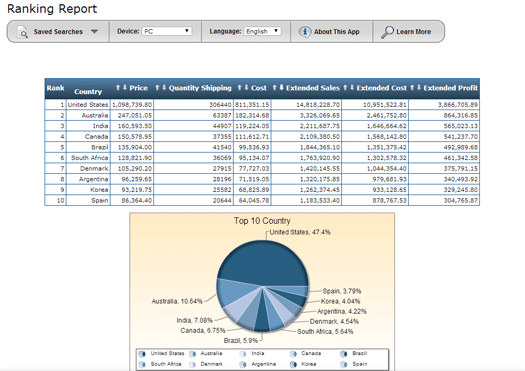
The ranking (or top N) report creates variable rankings, across multiple dimensions, while specifying various selection criteria at run-time. In short, it lets you rank any aspect of your data from best to worst, or vice-versa. It lets users choose from a number of different criteria at run-time, and then instantly run a top/bottom ranking report complete with a graph.
Why use a ranking report?
Ranking reports are simple, yet powerful end-user reporting tools. An IT department can create a single ranking report, include the necessary selection criteria (like product sales, customer info, sales data, etc..), and turn it over to the end users. Based on their desired selection criteria, end users can easily generate top/bottom ranking reports for different aspects of the business.
Sample ranking report, which ranks profitability by country
How are ranking reports used?
As the name implies, this reporting type delivers top-N style rankings. For example, businesses use ranking reports to:
Rank their most profitable products over a select time-frame
Understand their best and worst performing salespeople
View their top/bottom retail locations over the past year
and more
Going one step further, some even combine ranking reports with multi-tenancy. This lets multiple user levels access the same ranking report, but only view the data they’re authorized to view. This approach lets the IT department create just one ranking report, and distribute to all user levels.
Ranking report demo
Here’s a great demo of a ranking report in action. Select from the criteria, click “Run Report,” and you’re all done!
5 Industry Examples of Ranking Reports
Ranking reports work across most industries. Here are five concrete examples that show why this report type is so versatile.
1. Manufacturing: Top 10 Defective Parts by Cost
A quality manager selects a date range and ranks parts by total defect cost. The report instantly shows which components are driving the most waste, so the team can prioritize supplier reviews or process changes.
2. Healthcare: Bottom 5 Departments by Patient Satisfaction Score
Hospital administrators rank departments by patient satisfaction over the past quarter. Instead of sifting through spreadsheets, they see the lowest-performing departments at a glance and can drill into the data to understand why.
3. Retail: Top 20 Products by Revenue (by Region)
A regional sales director runs a ranking report filtered by their territory. They see their top-selling products, compare against the prior period, and adjust inventory or promotional spending accordingly.
4. Distribution: Bottom 10 Customers by Profit Margin
A CFO ranks customers by profit margin to identify accounts that generate revenue but cost more to serve than they return. This data drives pricing conversations and contract renegotiations.
5. Financial Services: Top 15 Loan Officers by Approval Rate
A branch manager ranks loan officers by approval-to-application ratio. High performers are identified for mentoring roles. Officers with unusually low or high rates are flagged for review.
Ranking Reports vs. Dashboards: When to Use Each
Ranking reports and dashboards do different jobs.
Dashboards give a broad, at-a-glance view of multiple KPIs at once. They’re built for monitoring. A dashboard might show you that revenue is down, but it won’t tell you which products or regions are responsible.
Ranking reports answer a specific question: “What are the top (or bottom) performers across a given dimension?” They let users change the criteria at run-time, so a single report can answer dozens of different questions.
The most effective reporting strategy uses both. Dashboards for daily monitoring. Ranking reports for the follow-up analysis when a number looks off.
How AI Is Changing Ranking Reports in 2026
Traditional ranking reports require the user to choose what to rank and how. In 2026, AI adds automated anomaly detection on top. Instead of waiting for a manager to run a “bottom 10” report, an AI-enhanced system can proactively flag when a product, location, or employee falls outside expected ranges.
What matters is governance. AI-driven alerts are only useful if they run over accurate, governed data. If your ranking reports pull from ungoverned spreadsheets or siloed systems, AI amplifies the problem instead of solving it. It needs clean data in a real database, with access that IT controls.
How to Build Ranking Reports with m-Power
m-Power is mrc’s low-code development platform. It runs directly over a company’s existing databases, so an IT team can build ranking reports, dashboards, and AI tools without migrating data. Here’s what building a ranking report looks like:
Connect to your database.m-Power runs directly over DB2, SQL Server, MySQL, Oracle, and PostgreSQL. No data extraction or migration is needed.
Select your ranking criteria. Using a point-and-click interface, choose the fields users can rank by (product, region, salesperson, time period, etc.).
Set run-time parameters. Let users choose how many results to display (Top 5, Top 10, Top 50) and the sort direction (best to worst or worst to best) at run-time.
Add charts and graphs.m-Power generates interactive charts alongside the tabular data, so users get both the numbers and the visual story.
Apply security. Use row-level security so each user only sees the data they are authorized to access. One report serves every role in the organization.
The build takes minutes. And because m-Power is sold as a perpetual license with unlimited users, you can give ranking reports to every department without adding per-user costs.
John Perrin, CIO at Farner-Bocken, put it this way: “Easily the best technology investment I’ve made in my 20+ year career.”
Want to see it in action?Request a demo and we will build a ranking report over your own data so you can see how it works in your environment.
Frequently Asked Questions
What is the difference between a ranking report and a sorted list?
A sorted list displays every record in order. A ranking report limits the results to the top or bottom N records based on user-selected criteria, and typically includes a chart. The ranking report is meant for quick analysis rather than reviewing every row.
Can non-technical users run ranking reports on their own?
Yes, if the report is built correctly. The IT department creates the report and defines the available criteria. End users then select what they want to rank, choose how many results to display, and run the report themselves. No technical knowledge is needed.
How are ranking reports different from dashboards?
Dashboards provide a high-level view of multiple metrics at once. Ranking reports answer a specific question: “What are the top or bottom performers in this area?” Dashboards are for monitoring. Ranking reports are for targeted analysis. Most organizations benefit from using both together.

 Summary: Enterprise systems pose something of a “Catch-22.” If you don’t customize the system, it won’t perfectly fit your needs. If you do customize it, you’re locked into that system. In this article, you’ll learn how to avoid these problems and customize your enterprise system without locking your company down.