Every new tech trend comes with varying levels of acceptance among IT departments. When the web first rolled around, some recognized its value and jumped on board. Others sat back and waited. I’ve noticed similar responses to the recent major trends, like mobile and cloud computing.
Now, I’m not going to sit here and tell you which trends to adopt and which to ignore. After all, every company has different needs.
However, I’d like to take a step beyond the recent trends, and focus instead on the new “realities” brought about by these trends. What’s the difference between a trend and a reality? While you can choose whether or not to adopt a trend, realities aren’t up for debate. They’re happening, whether you like it or not. You can’t sit back and see what others are doing. You must adapt.
So, what are these new realities? While this isn’t an exhaustive list, here are 5 realities to which IT departments must adapt: …
Every week, I share the most interesting and useful tech articles that I’ve found over the past week. This week’s top articles focus on mobile skills IT pros must master, security statistics that show we need to reinvent enterprise IT, and more. I hope you find them useful:
Developing enterprise mobile applications
Mobile applications seem like a rite of passage for many enterprise development teams until they face the reality of supporting multiple devices and platforms. If your company doesn’t have one or two enterprise mobile applications, the perception is that the organization is getting left behind.
Top 10 mobile skills IT Pros must master
In a recent blog post, Gartner outlined 10 mobile technologies and skills that organizations need to master over the next two to three years. Additional training for enterprise IT staff will be especially critical during this time since mobile technology is evolving so quickly, with new risks as well as new capabilities emerging.
Security statistics show we need to reinvent enterprise IT
It seems that in a headlong race to become more agile and deliver on the innovation that the organization and the marketplace demands, enterprises are taking a fairly slack approach towards security. But perhaps this is an unavoidable reaction to the pressures organizations are under – is it feasible to deliver product more rapidly while still remaining secure?
What to consider when selecting a legacy modernization vendor Legacy modernization isn’t an easy task, which is why in some situations an organization may opt to bring in a service provider. To achieve the maximum cost-saving benefits, it’s crucial that the relationship between a client and a vendor be solid. An organization’s laundry list of business needs and provider deliverables needs to be kept in mind when it’s hiring consultants and buying products for business transformation needs.
Updated September 2026 with industry examples, a comparison with dashboards, a section on AI, and an FAQ.
Today, let’s explain an important type of web report that could be a useful addition to any company’s reporting repertoire: the ranking report (also known as “the top N report”). What is it, why is it important, and how does it help your company? Let me explain.
The ranking (or top N) report creates variable rankings, across multiple dimensions, while specifying various selection criteria at run-time. In short, it lets you rank any aspect of your data from best to worst, or vice-versa. It lets users choose from a number of different criteria at run-time, and then instantly run a top/bottom ranking report complete with a graph.
Why use a ranking report?
Ranking reports are simple, yet powerful end-user reporting tools. An IT department can create a single ranking report, include the necessary selection criteria (like product sales, customer info, sales data, etc..), and turn it over to the end users. Based on their desired selection criteria, end users can easily generate top/bottom ranking reports for different aspects of the business.
Sample ranking report, which ranks profitability by country
How are ranking reports used?
As the name implies, this reporting type delivers top-N style rankings. For example, businesses use ranking reports to:
Rank their most profitable products over a select time-frame
Understand their best and worst performing salespeople
View their top/bottom retail locations over the past year
and more
Going one step further, some even combine ranking reports with multi-tenancy. This lets multiple user levels access the same ranking report, but only view the data they’re authorized to view. This approach lets the IT department create just one ranking report, and distribute to all user levels.
Ranking report demo
Here’s a great demo of a ranking report in action. Select from the criteria, click “Run Report,” and you’re all done!
5 Industry Examples of Ranking Reports
Ranking reports work across most industries. Here are five concrete examples that show why this report type is so versatile.
1. Manufacturing: Top 10 Defective Parts by Cost
A quality manager selects a date range and ranks parts by total defect cost. The report instantly shows which components are driving the most waste, so the team can prioritize supplier reviews or process changes.
2. Healthcare: Bottom 5 Departments by Patient Satisfaction Score
Hospital administrators rank departments by patient satisfaction over the past quarter. Instead of sifting through spreadsheets, they see the lowest-performing departments at a glance and can drill into the data to understand why.
3. Retail: Top 20 Products by Revenue (by Region)
A regional sales director runs a ranking report filtered by their territory. They see their top-selling products, compare against the prior period, and adjust inventory or promotional spending accordingly.
4. Distribution: Bottom 10 Customers by Profit Margin
A CFO ranks customers by profit margin to identify accounts that generate revenue but cost more to serve than they return. This data drives pricing conversations and contract renegotiations.
5. Financial Services: Top 15 Loan Officers by Approval Rate
A branch manager ranks loan officers by approval-to-application ratio. High performers are identified for mentoring roles. Officers with unusually low or high rates are flagged for review.
Ranking Reports vs. Dashboards: When to Use Each
Ranking reports and dashboards do different jobs.
Dashboards give a broad, at-a-glance view of multiple KPIs at once. They’re built for monitoring. A dashboard might show you that revenue is down, but it won’t tell you which products or regions are responsible.
Ranking reports answer a specific question: “What are the top (or bottom) performers across a given dimension?” They let users change the criteria at run-time, so a single report can answer dozens of different questions.
The most effective reporting strategy uses both. Dashboards for daily monitoring. Ranking reports for the follow-up analysis when a number looks off.
How AI Is Changing Ranking Reports in 2026
Traditional ranking reports require the user to choose what to rank and how. In 2026, AI adds automated anomaly detection on top. Instead of waiting for a manager to run a “bottom 10” report, an AI-enhanced system can proactively flag when a product, location, or employee falls outside expected ranges.
What matters is governance. AI-driven alerts are only useful if they run over accurate, governed data. If your ranking reports pull from ungoverned spreadsheets or siloed systems, AI amplifies the problem instead of solving it. It needs clean data in a real database, with access that IT controls.
How to Build Ranking Reports with m-Power
m-Power is mrc’s low-code development platform. It runs directly over a company’s existing databases, so an IT team can build ranking reports, dashboards, and AI tools without migrating data. Here’s what building a ranking report looks like:
Connect to your database.m-Power runs directly over DB2, SQL Server, MySQL, Oracle, and PostgreSQL. No data extraction or migration is needed.
Select your ranking criteria. Using a point-and-click interface, choose the fields users can rank by (product, region, salesperson, time period, etc.).
Set run-time parameters. Let users choose how many results to display (Top 5, Top 10, Top 50) and the sort direction (best to worst or worst to best) at run-time.
Add charts and graphs.m-Power generates interactive charts alongside the tabular data, so users get both the numbers and the visual story.
Apply security. Use row-level security so each user only sees the data they are authorized to access. One report serves every role in the organization.
The build takes minutes. And because m-Power is sold as a perpetual license with unlimited users, you can give ranking reports to every department without adding per-user costs.
John Perrin, CIO at Farner-Bocken, put it this way: “Easily the best technology investment I’ve made in my 20+ year career.”
Want to see it in action?Request a demo and we will build a ranking report over your own data so you can see how it works in your environment.
Frequently Asked Questions
What is the difference between a ranking report and a sorted list?
A sorted list displays every record in order. A ranking report limits the results to the top or bottom N records based on user-selected criteria, and typically includes a chart. The ranking report is meant for quick analysis rather than reviewing every row.
Can non-technical users run ranking reports on their own?
Yes, if the report is built correctly. The IT department creates the report and defines the available criteria. End users then select what they want to rank, choose how many results to display, and run the report themselves. No technical knowledge is needed.
How are ranking reports different from dashboards?
Dashboards provide a high-level view of multiple metrics at once. Ranking reports answer a specific question: “What are the top or bottom performers in this area?” Dashboards are for monitoring. Ranking reports are for targeted analysis. Most organizations benefit from using both together.
Every week, I share the most interesting and useful tech articles that I’ve found over the past week. This week’s top articles focus on people in your organization who grow legacy code, mobile’s next great leap, and more. I hope you find them useful:
App-pocalypse now
Companies keep asking “how can we get people to find and install our amazing app” instead of the one question they really should have asked. “Why are we building an app in the first place?” With the proliferation of mobile apps, building a native mobile app for the sake of building an app is a waste. No one will find it among the hundreds of thousands of apps already in the app store. Instead, focus your attention on making your current applications mobile-ready. …
Over the past couple of years, we’ve seen the business world slowly adapt to the rise of mobile devices. Some businesses have jumped in with both feet, while others have moved more cautiously. I believe we’ll see the pace quicken dramatically this year, as more businesses rush to jump on board.
Why will 2014 be a big year for mobile in the business world? We’ve reached a point where businesses can’t afford to ignore the trend any longer. What do I mean? Here are a few examples:
Mobile browser usage share recently hit 20%. That means one out of every 5 customers, employees, or prospects that visit a site does so on a mobile browser.
The percentage of employees using their own devices for work-related tasks has grown exponentially. I’ve seen studies that put this number anywhere from 50-70%, but I’d wager the actual numbers far exceed those estimations.
Mobile is becoming the foundation for new technological advances. For instance, the rise of trends like the “internet of things” and wearable technology revolve around mobile devices.
I believe this will be an exciting and eventful year for mobile in the business world. We’ll see mobile do everything from improve business efficiency to completely revolutionize industries. So, where is mobile headed this year from a business perspective? Here are 9 of the biggest enterprise mobile trends to watch in 2014: …
Today, let’s explain an important term in the world of application development: multi-tenancy. What is it, why is it important, and how does it help your company? Let me explain.
The concept of multi-tenancy revolves around a single instance of a software application that serves different users/customers (also called “tenants”). In a multi-tenant application, different users access the same application, but see different data. …
Every week, I share the most interesting and useful tech articles that I’ve found over the past week. This week’s top articles focus on the new CIO mandate, how to screw up your enterprise mobile app, and more. I hope you find them useful:
Saving the dry lifeless soul of enterprise software
Although enterprise software is pervasive in business, the products and industry tend to be flat, boring, and too often devoid of human expression. The problem is, consumers now expect more. They expect the same level of usability they find in consumer apps. IT departments face a new reality: Create software that users want to use…or risk being bypassed. …
As technology plays an increasingly important role in the business, IT departments are evolving. They’re moving from a back-office function that supports the business to a true business driver.
The problem is, many of these CIOs and IT leaders are still stuck working with limited budgets. IT budgets took a beating in the recession a few years back, and many still haven’t recovered. In fact, according to Computerworld’s yearly report, 64% of IT leaders report either a flat or smaller budget this year over last.
The question is, how can CIOs and IT leaders make the most out of their budgets? While being called upon to play a larger role in the business, many must do so with limited resources. How can they succeed?
Today, I’d like to answer that question and explore a few ways CIOs and IT leaders can save money. Now, when I say “save money,” I’m referring to long-term savings. I’m not interested in short-term cut-backs with long-term consequences. I’m interested in money-saving methods that will not only reduce costs, but prepare your company for future success.
These tips aren’t easy, but will produce significant savings if followed. All that being said, here you go: Five money-saving tips for CIOs and IT leaders: …
I’m happy to announce that m-Power’s reporting and Business Intelligence (BI) capabilities just received a major boost! We just released an update that includes much improved graphing and charting capabilities, and I think you’ll love it.
Now, you’ll still find all of the charting features you’ve come to expect out of m-Power, like chart drill-downs, tooltips, mobile charting capabilities, etc… We didn’t remove any existing features. We did, however, add some new capabilities that will help you create better web applications with m-Power. For instance, m-Power users can now: …
Every week, I share the most interesting and useful tech articles that I’ve found over the past week. This week’s top articles focus on ways to improve IT productivity, lessons for CIOs in the age of the cloud, and more. I hope you find them useful:
Modern developers are caught between a rock and a hard place. On one hand, businesses are requiring faster application delivery from their development staff. As software plays an increasingly important role in the modern business, developers regularly face impossible deadlines.
On the other hand, web application development is becoming more complex. For instance, as outlined in this article, modern developers must create applications that adapt to any device, port to any platform, integrate with other services, and withstand increasingly sophisticated attacks. Whew!
The big problem: With these changing requirements and growing demands for faster development, developers struggle to keep up. Certain development aspects are bound to fall through the cracks.
As it turns out, that is exactly what’s happening…with security. Despite the growing importance of proper security, many developers aren’t following basic security principles. How bad is it? According to this study from last year, 99% of applications have one or more serious vulnerabilities.
Today, let’s examine this problem. While I know we can’t address every security mistake developers make, we can highlight the most important principles. What basic security guidelines should every modern web developer follow? How can you protect your web applications from being easy targets for an attack? While the list could be much larger, I’ve rounded up 7 of the most important security tips every developer must follow, and listed them below: …
Every week, I share the most interesting and useful tech articles that I’ve found over the past week. This week’s top articles focus on the “Build vs. Buy” myth, BYOD, and more. I hope you find them useful:
It’s Not Whether To BYOD or Not to BYOD, It’s How To
With the workforce becoming increasingly mobile, businesses must find a way to balance productivity, affordability and security to meet current and future workforce demands. To read more about one secure way to handle BYOD, check out this article. …
Gartner recently predicted that Business Intelligence (BI) and Analytics will remain a top focus for CIOs through 2017. As the benefits of a data-driven decision-making process become more evident, we’ll see most businesses adopt a BI strategy in one form or another over the next few years.
The only problem: Many businesses still don’t quite understand BI. They have a general idea, but the concept remains clouded in misconceptions. These misconceptions keep many businesses from adopting BI, or from taking full advantage of its potential.
Today, I’d like to address these misconceptions, and explain why they’re false. So, what are the biggest areas of confusion surrounding BI? While the list could be much larger, here are 9 of the most common BI misconceptions: …
What’s the next big tech trend? How will the web change in 5 years? Who knows? Sure, people like to speculate and make bold predictions. But, they don’t know what the future holds. I don’t know what the future holds. Neither do you.
One thing I do know: Whatever the future holds, we’re ready for it.
Every week, I share the most interesting and useful tech articles that I’ve found over the past week. This week’s top articles focus on the worst practices of cloud computing, the state of the CIO, and more. I hope you find them useful:
State of the CIO slideshow
In the annual “State of the CIO” research findings, nearly 50% of all CIOs admit that their IT departments aren’t considered a peer to the business. They aren’t looked upon as innovators, but cost centers. How can IT break free from this perception? …
A recent Forrester study highlights a major shift in the business landscape: More and more, software development plays an increasingly important role in a company’s competitive edge. According to the study, “Companies that are able to innovate quickly with software will outcompete traditional market leaders.”
There’s just one problem: As the study points out, software development is still a problem for the majority of companies. Most are not able to deliver software solutions as fast as the business leaders want them. photo credit: Nathan E Photography via photopincc
The fact is, as business moves to the web, software development speed plays a crucial role in a company’s success. The old software development methodologies–in which development projects required months (or even years) to complete–will no longer work. Businesses must permanently shift their development cycle into the “days and weeks” range.
How can businesses improve their development speed so drastically? While the answer to that question varies by company, today I’d like to focus on one area that’s relevant to most businesses: improving developer productivity.
What separates the productive developer from the unproductive? What do the productive developers do differently? How can developers become more productive? We posed those questions to a few experts in the area, and have compiled their advice below. Here are 7 habits of highly productive developers: …
According to Forrester, “approximately half of ERP customers are currently on releases that are two versions behind the current release, which may be four years old or more.” For these companies, upgrading to a new ERP version or package is often too difficult or expensive. Past customizations or enhancements have virtually locked these companies into their current ERP versions. An upgrade represents countless dollars and months of extra work—a project that most companies can’t afford to undertake.
The sad reality: These companies are locked into their enterprise system. Many feel tied to the old features and capabilities of their outdated systems. …
Every week, I share the most interesting and useful tech articles that I’ve found over the past week. This week’s top articles focus on hybrid IT roles you’ll need in 2014, how to control Shadow IT, and more. I hope you find them useful:
5 Ways to Decide If Your Business Needs a Mobile App
Can your company still capitalize on mobile devices without creating mobile apps? Of course! Very few companies actually require native mobile apps. Chances are, creating web apps that automatically adapt to mobile devices is all most companies need. …
Every week, I share the most interesting and useful tech articles that I’ve found over the past week. This week’s top articles focus on the hot IT job skills for 2014, top BI trends, and more. I hope you find them useful:
Top BI trends for 2014
Where is Business Intelligence heading in the next year? Besides the popular choices like cloud and mobile BI, I believe we’ll see more companies adopt self-service BI options. These solutions will let end users create their own BI apps, freeing the IT department up for more important tasks. …
In his book, “The Tipping Point,” Malcolm Gladwell explains how it’s often the little things that make the biggest difference. We might assume that big results come from big changes, but that’s not always the case.
I think the same holds true for web application usability. Sometimes it’s the small UI elements that make the biggest impact. If your web applications frustrate or confuse users, or if you just want to improve usability, you might just need a few small changes.
Today, let’s take a closer look at web application usability–specifically focusing on those small user interface elements or concepts that make a big difference. I’ve compiled 7 simple ways to improve your web application’s usability, without performing a major overhaul. …

 Every new tech trend comes with varying levels of acceptance among IT departments. When the web first rolled around, some recognized its value and jumped on board. Others sat back and waited. I’ve noticed similar responses to the recent major trends, like mobile and cloud computing.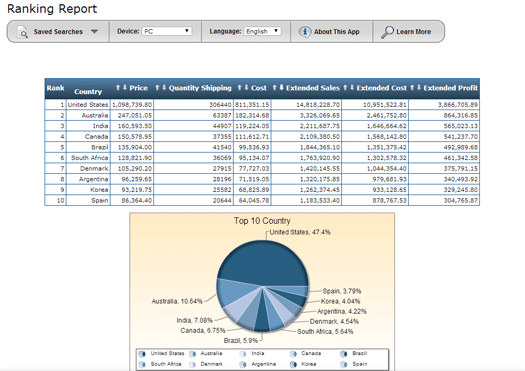
 I’m happy to announce that m-Power’s reporting and Business Intelligence (BI) capabilities just received a major boost! We just released an update that includes much improved graphing and charting capabilities, and I think you’ll love it.